Goal Zero Yeti PRO 4000 Solar Input Limits: Low-Voltage vs HPP+
Compare the Yeti PRO 4000’s low-voltage DC and HPP+ solar inputs, including the separate panel arrangement guidance.
The 120 V Goal Zero Yeti PRO 4000 has separate low-voltage DC and HPP+ high-voltage charging paths. They have different voltage, current, power, and connection guidance. Use the user guide for the exact Yeti PRO 4000 revision and accessory; do not apply limits from the older Yeti X or another Goal Zero model.
Compare the two solar paths
| Input path | Documented voltage range | Current limit | Power limit |
|---|---|---|---|
| Low-voltage DC | 12.3–28 V | 10 A | 275 W |
| HPP+ high-voltage DC | Conflicting source statements | Product page: 30 A; guide table: 40 A | 3,000 W |
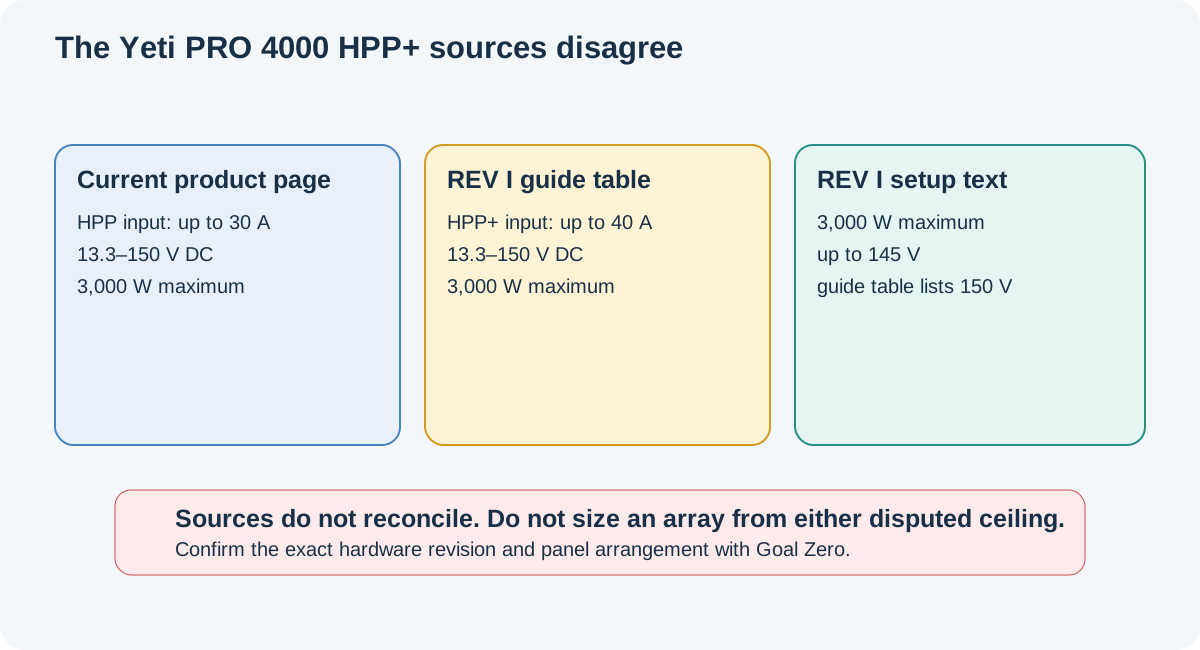
These values are for the Yeti PRO 4000 and identify different input hardware. An array within the HPP+ watt ceiling still has to fit its voltage and current limits and the manual’s permitted arrangement. The low-voltage port is not a lower-cost substitute for the HPP+ path when the panel array exceeds its limits.
Read the HPP+ limits with their source context
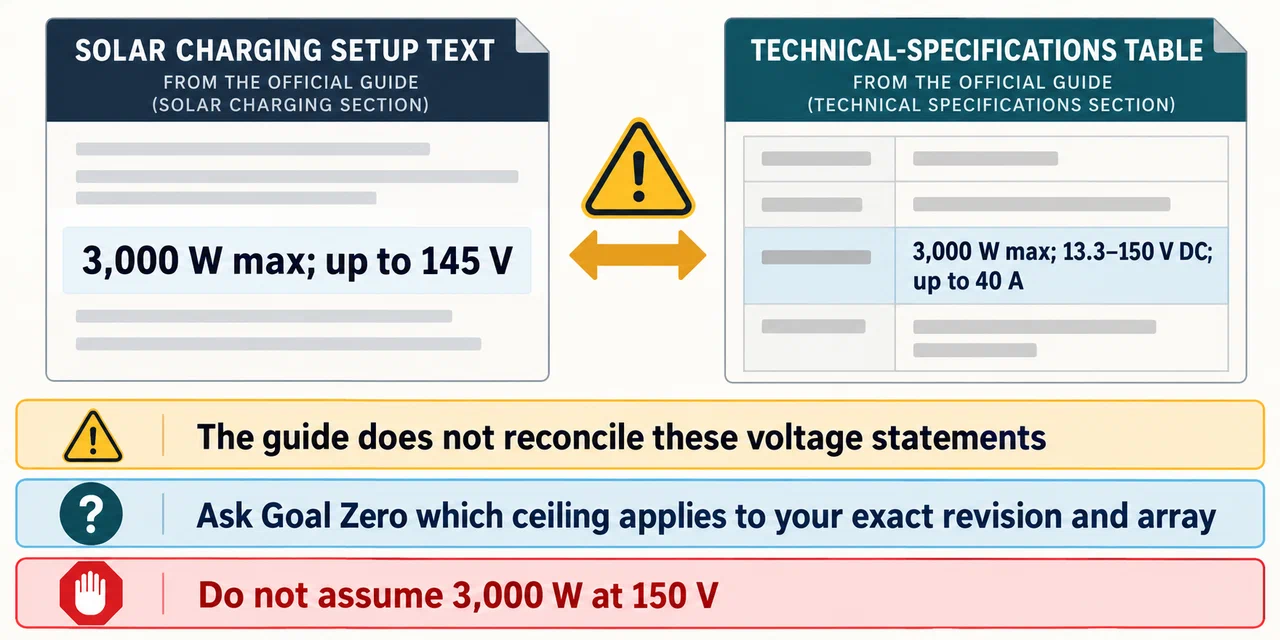
The current Goal Zero product page for the Yeti PRO 4000 lists HPP High Voltage Input at 3,000 W maximum, 13.3–150 V, and up to 30 A. The REV I product guide’s technical table lists 3,000 W maximum, 13.3–150 V DC, and up to 40 A. The same guide’s Solar Charging setup text says 3,000 W maximum up to 145 V. These manufacturer sources do not reconcile the 30 A versus 40 A statements or the guide’s 145 V versus 150 V statements. Do not select a panel arrangement using either disputed current or voltage ceiling. Ask Goal Zero to confirm the limits for the exact station revision, panel set, and cable before sizing or connecting an array.
Follow the HPP+ arrangement guidance
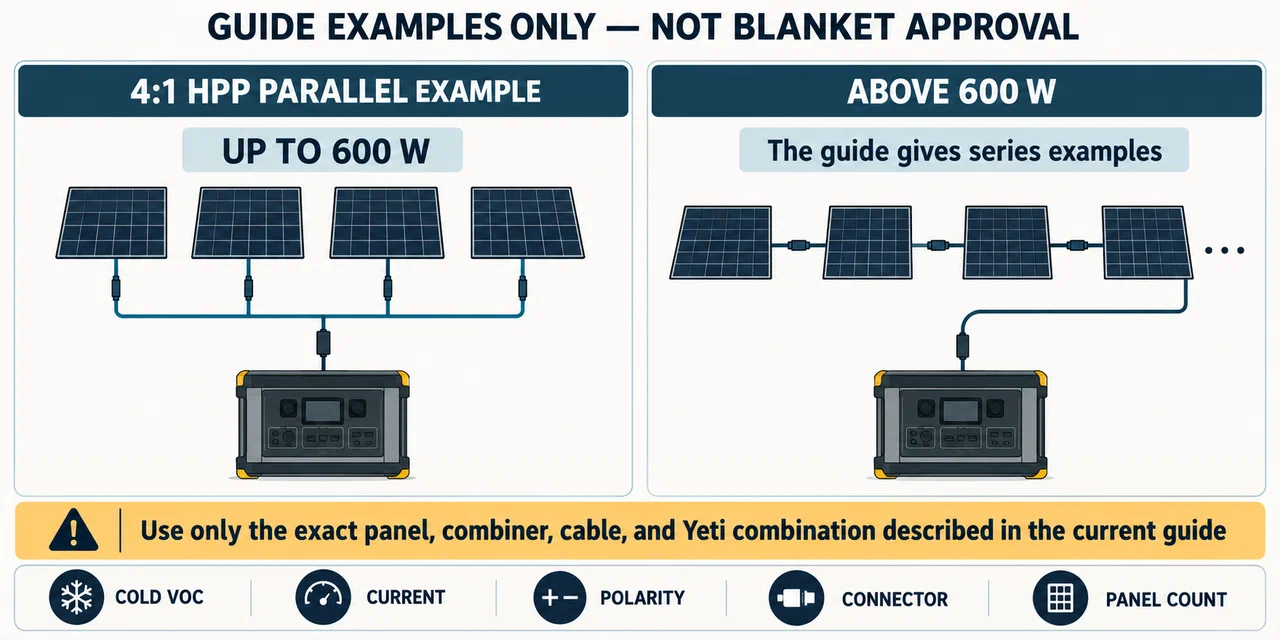
The guide includes a 4:1 HPP parallel arrangement up to 600 W. For configurations above 600 W, it gives series examples. Those are model-specific examples, not blanket approval to wire any four panels in parallel or to build a string from arbitrary modules. Follow the exact panel, combiner, cable, and Yeti instructions. Verify the actual HPP+ input accessory and panel combination listed in the current guide.
In a series string, voltage adds; in parallel branches, current adds. Compare the resulting values with the HPP+ input and the panel manufacturer’s ratings. Include cold-weather open-circuit voltage (Voc) at the minimum expected module temperature. Confirm the current rating of each cable and connection method, along with polarity and connector compatibility. If the guide’s example does not match your panels or accessory, do not extrapolate the diagram; request model-specific confirmation from Goal Zero.
Do not confuse HPP+ with connector fit
HPP+ is a specific Goal Zero input and supported accessory path, not a universal solar connector standard. A third-party plug that physically fits is not evidence that its wiring, polarity, voltage, current, or panel arrangement is supported. Do not join low-voltage and HPP+ connections or feed one array into both inputs unless the current user guide expressly permits the setup.
Check the exact product revision and input labels before use. Use the specified adapter and connection sequence, inspect cables for damage, and keep the setup within the environmental and placement instructions. Stop if a connector is loose, wet, overheated, or damaged. A protection threshold is not a valid operating target, and no panel count should be inferred from the 3,000 W headline alone.
Build a safe selection checklist
- Identify the Yeti PRO 4000 model and current guide revision.
- Choose low-voltage or HPP+ based on the compatible panel and cable system.
- Check Voc, Vmp, Imp, Isc, temperature behavior, total watts, and the manual’s array arrangement.
- Verify panel count, connector, polarity, accessory approval, and all individual limits.
- Ask Goal Zero if the exact panel set and arrangement are not covered by its guide.
For help interpreting panel ratings and other station inputs, see the solar-input sizing guide. It explains the arithmetic without replacing Yeti-specific arrangement instructions.
Key Points
- The HPP+ current and voltage limits conflict across Goal Zero’s current product page and REV I guide.
- The guide’s parallel and series examples apply only to documented compatible configurations.
- HPP+ connector fit alone does not establish third-party panel approval.
- Check voltage, current, power, temperature, cable, polarity, and the exact product revision.
- Do not extrapolate panel-count examples to an undocumented arrangement.