Vitamix 5200 Runtime from a Portable Power Station
Check whether the station supports a Vitamix 5200’s brief motor use and estimate energy from the complete preparation task rather than its motor label.
Blending is usually intermittent, but a motor can demand substantial output while it starts and while processing thick ingredients. A station’s energy capacity determines how many tasks may fit only after its inverter can operate the blender. Read the exact model label and measure the recipe you expect to make.
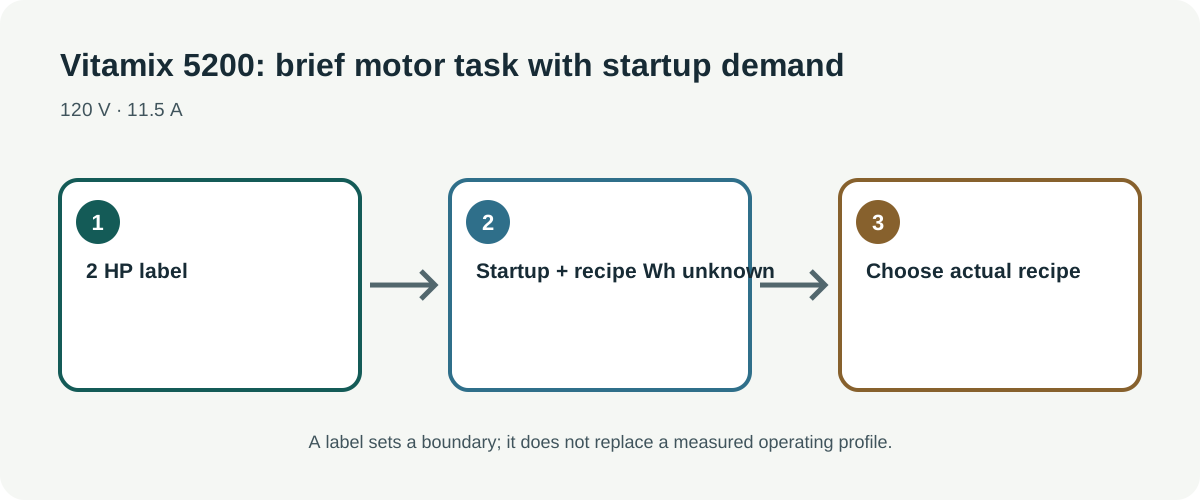
What the 5200 product listing says
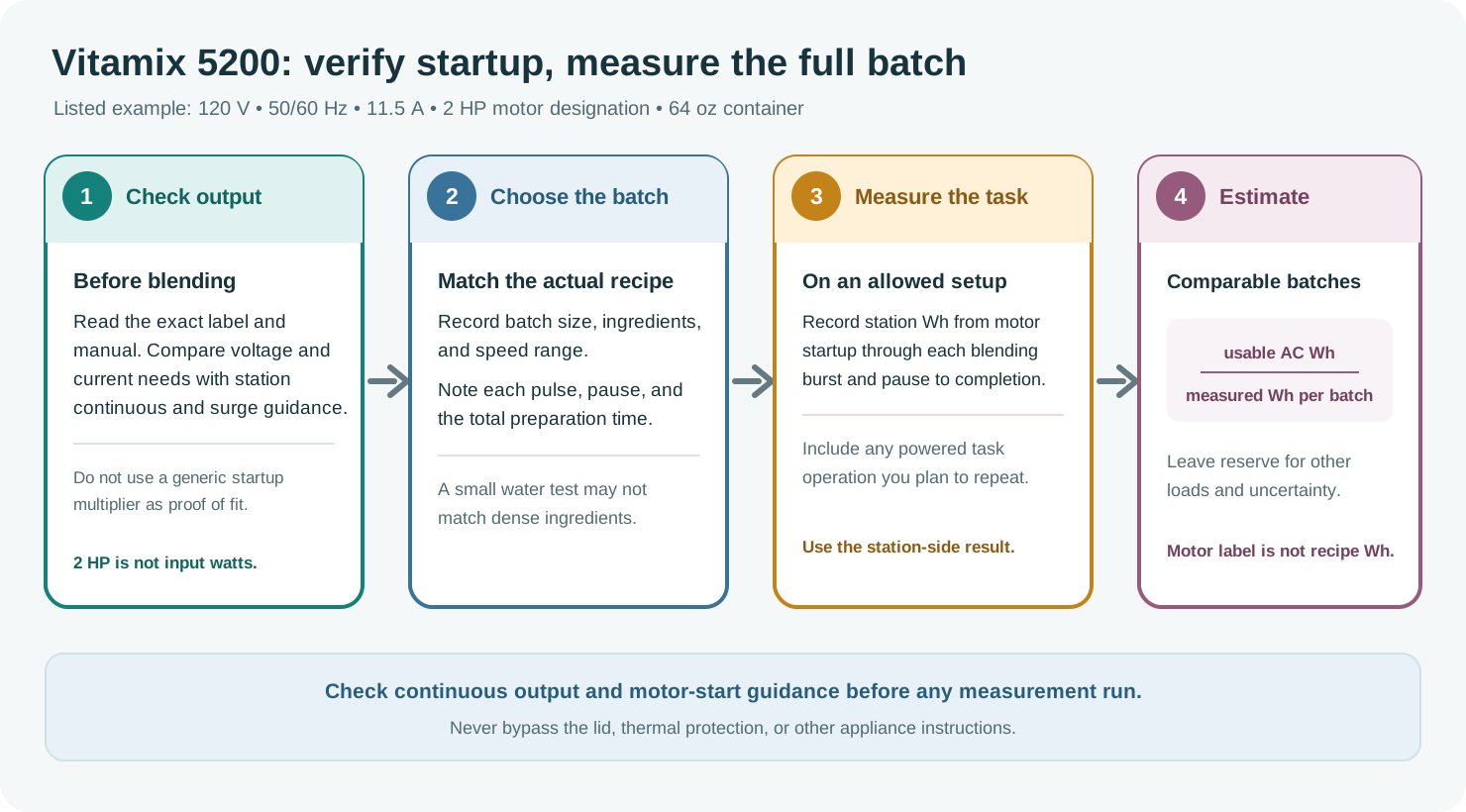
Vitamix lists the 5200 at 120 V, 50/60 Hz, 11.5 A, with a 2 HP motor designation and a 64 oz container. The product information also describes a radial cooling fan and thermal protection. These are model specifications, not a steady watt draw at every speed, a startup measurement, or watt-hours per recipe. The horsepower label is not a substitute for measured electrical input or task energy.
Check the exact 5200 label and manual, especially if the unit is old or sold for another market. Container size and ingredients affect the task, but the source does not quantify the energy for a particular batch. Do not treat 120 V multiplied by 11.5 A as a measured continuous draw or use the 2 HP designation to claim a particular station size.
Verify the motor can start safely
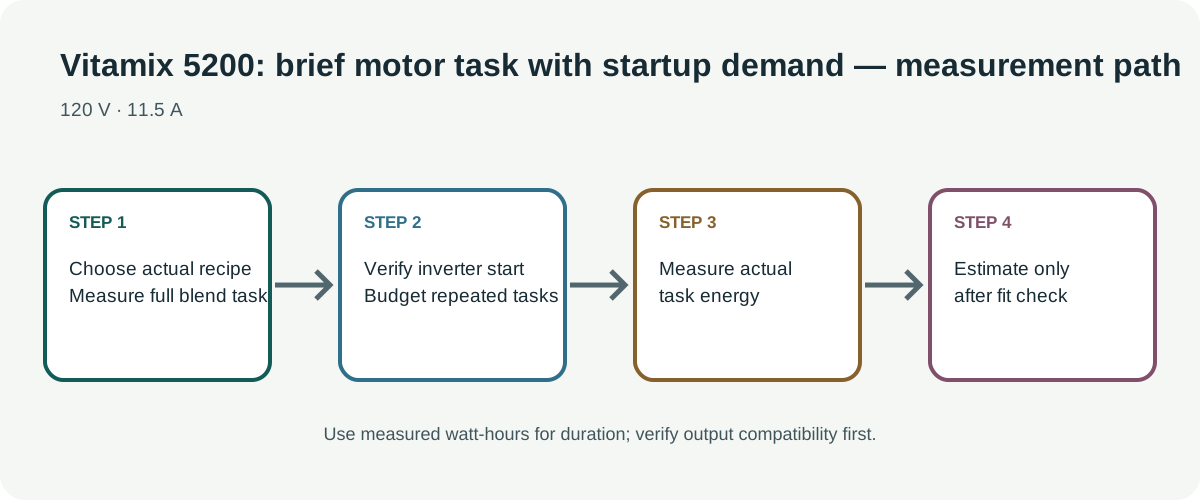
Compare the blender’s supply and current requirement with the station’s continuous AC output, and review surge capability for a motor load. A current label alone does not show locked-rotor or startup demand. Use manufacturer instructions and an appropriate meter where needed; do not apply a generic multiplier as proof that the station will run it. Include other loads and ensure the outlet, cord, grounding, and ventilation remain within product instructions.
Place the blender on a stable, dry surface and use its container, lid, and tamper only as described by Vitamix. Do not operate the motor continuously beyond its manual guidance or bypass thermal protection. If the station overloads, stop and follow the station and appliance troubleshooting instructions instead of repeated resets.
Measure one complete preparation task
With a permitted pairing, record station-side Wh from startup through all blending bursts, pauses, and cleaning-related operation if it draws power. Note recipe, batch size, ingredients, speed range, number and length of pulses, and total time. A single low-load water test will not represent dense frozen ingredients or a large batch. Repeat the task that matters to your outage plan rather than extrapolating from a brief display reading.
Use that total Wh to estimate comparable batches from the station’s usable AC energy and leave reserve for other loads. If you measure on the wall, account for the fact that the station will lose some energy in conversion. Without a task measurement, the manufacturer’s 11.5 A rating does not support a number of smoothies or minutes of operation.
Food preparation is only one part of the plan
A blender may be useful for a short task, but station capacity may be more valuable for refrigeration, communications, or medical equipment. Decide which loads have priority and prepare ingredients safely. A runtime estimate does not provide food-safety guidance or establish safe operation on a damaged, wet, or ungrounded setup.