Philips HP4940 Travel Hair Dryer Runtime from a Portable Power Station
Verify the HP4940’s dual-voltage setting and exact label, then use measured drying-session energy to plan a station load.
A travel hair dryer can have a much higher electrical load than its compact size suggests. Its voltage selector makes it important to identify the local supply and set the appliance correctly. The product’s worldwide-voltage description is not a guarantee that every power station supports the selected voltage or the dryer’s full input.
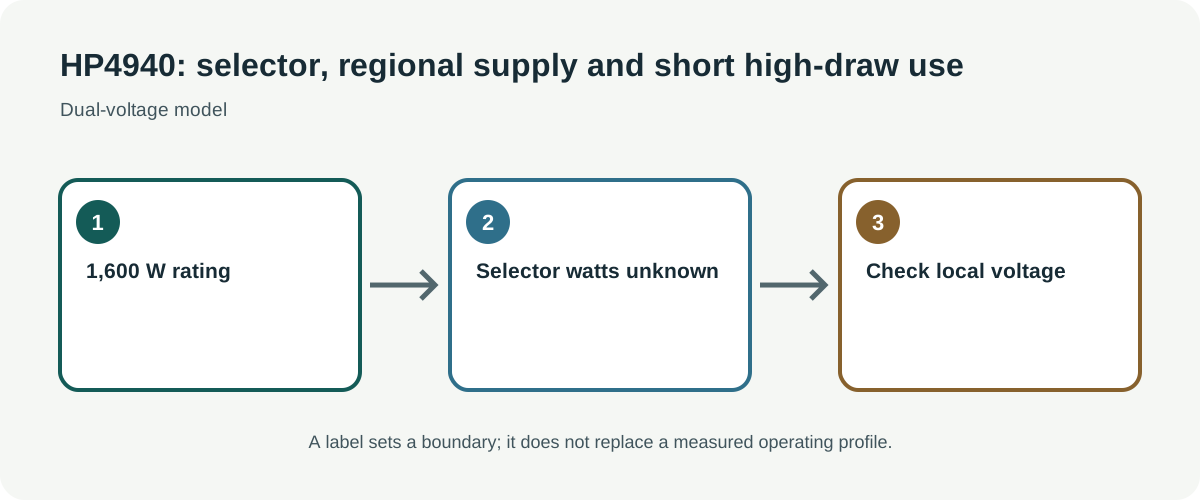
Keep the HP4940 facts model-specific
Philips lists the SalonDry HP4940/00 at 1,600 W, with three heat and speed combinations, and describes a dual-voltage design. The user manual directs the owner to set the voltage selector to match the local supply before connecting the appliance. The product page marks it discontinued. Neither source gives watts for each selector position, session energy, startup demand, or a power-station compatibility statement.
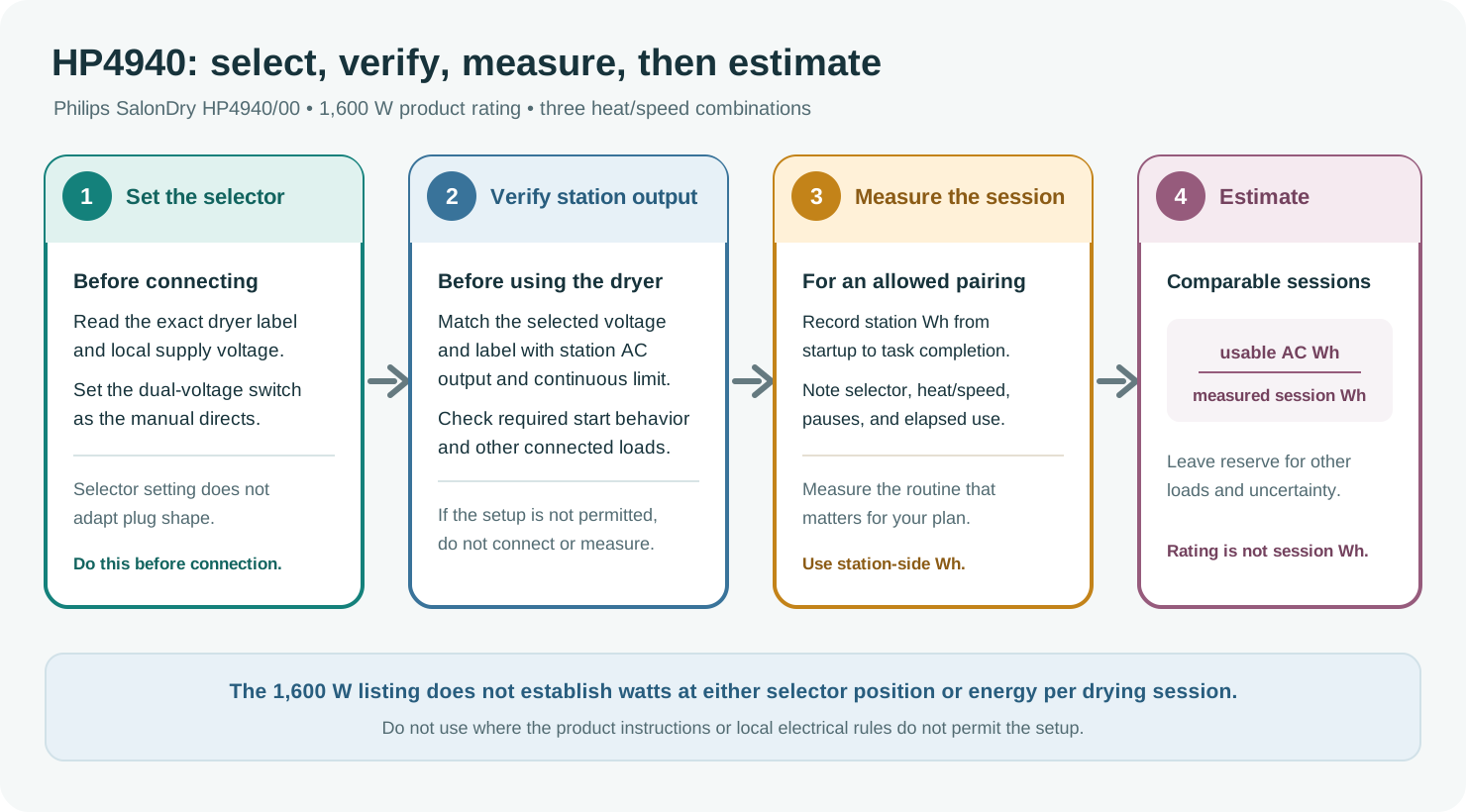
Check the label on the exact dryer and the instructions for its regional variant. Do not assume 1,600 W applies unchanged at both voltage settings or to another HP4940 family member; Philips does not provide mode-by-mode values in the cited evidence. The switch selects the dryer’s voltage configuration, but it does not adapt the plug shape or provide electrical isolation.
Check station output and use location
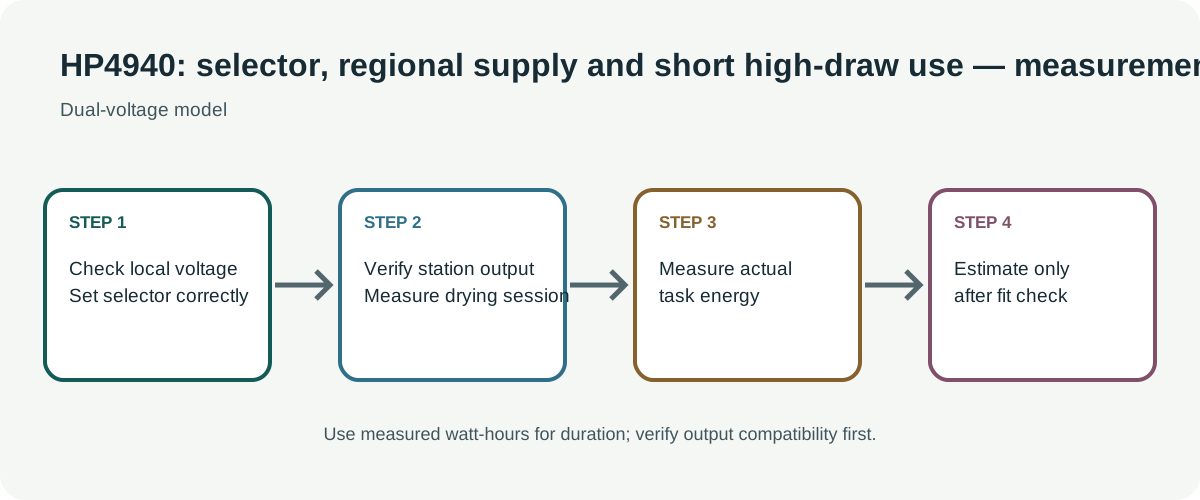
Confirm the voltage chosen on the hair dryer matches the station’s output and the manufacturer’s instructions. Compare the rated load with the station’s continuous limit and confirm any required surge behavior. A dual-voltage selector cannot compensate for an inverter with insufficient power. Account for other devices sharing the station, and do not use a USB output or an unapproved cable for a mains hair dryer.
Use the dryer in a location and manner allowed by its manual. Keep it and the station away from water, sinks, and wet surfaces; follow local bathroom electrical requirements. Do not alter the plug, remove grounding features, block the air inlet, or leave the dryer running unattended. If a plug or adapter becomes hot, stop and inspect the approved setup before using it again.
Measure the actual drying session
For a permitted pairing, record station-side Wh from startup through the complete drying task. Note the voltage selector position, heat/speed combination, elapsed use, pauses, and whether the dryer was used continuously or in short bursts. Measure the same hair-care routine that matters; a brief low setting does not represent a longer high-heat session. The source does not publish energy-per-session values, so a wattage label cannot fill that gap.
Compare the measured Wh with the station’s usable AC energy and hold back reserve for other loads. If measuring at the wall, remember that the station’s internal conversion losses are not included. If only a 1,600 W rating is known, any runtime calculation must state the assumed on-time and treat the result as an upper-load scenario, not an expected session duration.
Plan a lower-energy alternative
If hair drying is optional, air drying or a lower-heat routine can preserve battery for priority devices, but follow normal care and safety needs. Do not describe the dryer rating as continuous household heating or infer a daily hair-care runtime from its maximum label. For more general high-draw loads, see the space heater and cooking guide.