Pellet Stove and Furnace Electrical Loads on Battery Backup
Separate fuel heat from the electricity used by pellet-stove controls and RV furnace fans, then measure the exact unit's operating stages.
Pellets or propane may provide the heat, but the appliance still needs electricity for controls, ignition, fuel feed, fans, and sometimes pumps. A station estimate must account for each electrical stage and the appliance’s exact supply. A pellet stove with a 120 V AC plug and an RV furnace with a 12 V DC connection are different loads and cannot share one generic wattage or connection method.
Identify the appliance and supply path
Copy the complete model from the rating plate and use its current manual. Record supply voltage, frequency, rated current or watts, startup/ignition information, and any waveform or backup-supply instructions. For a 120 V pellet stove, check the station’s continuous AC output and start behavior against the manual. For an RV furnace, confirm whether the exact furnace is a 12 V DC appliance and whether its approved coach wiring and protection remain in place. A station’s AC outlet is not a direct substitute for an RV DC circuit, and this guide does not give wiring or combustion-system instructions.
Model examples show why the label and stages matter. The US Stove AP5780PS manual lists 125 W operational power and 310 W while the igniter is running; its ignition stage lasts at least 10 and no more than 12 minutes in that manual. The ComfortBilt HP22 manual lists 495 W startup and 207 W running at high, and calls for a pure-sine backup source. Its source material has 115 V versus 120 V wording across records, so verify the exact appliance label and revision rather than resolving the difference by assumption. These figures describe named models, not every pellet stove or a tested power-station pairing.
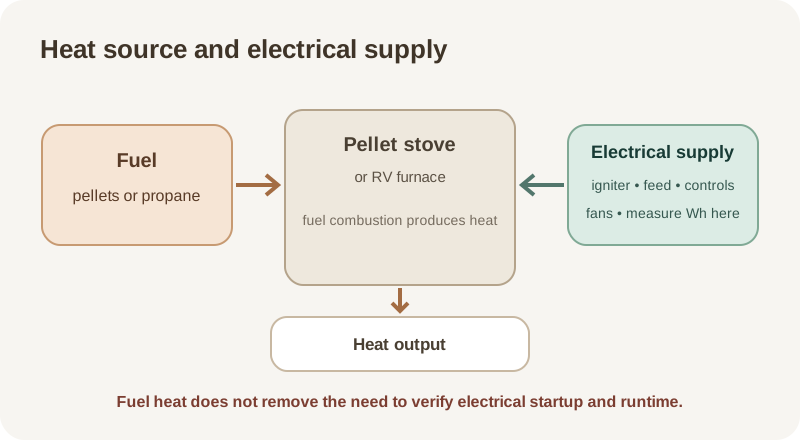
Measure both startup and a full operating interval
Use the meter and connection path allowed by the appliance manufacturer. For an AC unit, record the initial ignition demand and Wh through startup, steady operation, shutdown, and any restart that normally occurs. A meter with a slow display may miss a short peak; use appliance-manual limits and a suitably rated instrument where startup matters. Do not provoke repeated ignition cycles or bypass a safety control. For a 12 V furnace, measure at the supported system path and retain the actual system voltage; do not infer current from a different furnace’s rating.
Divide station output energy by measured energy for the intended interval. A pellet stove may have ignition demand plus ongoing auger and fan use; an RV furnace may cycle its blower and controls. Measure for the expected temperature and usage. Include other loads and reserve energy for startup, controls, and cold-weather station limits in the exact station manual. This calculation cannot establish startup compatibility.
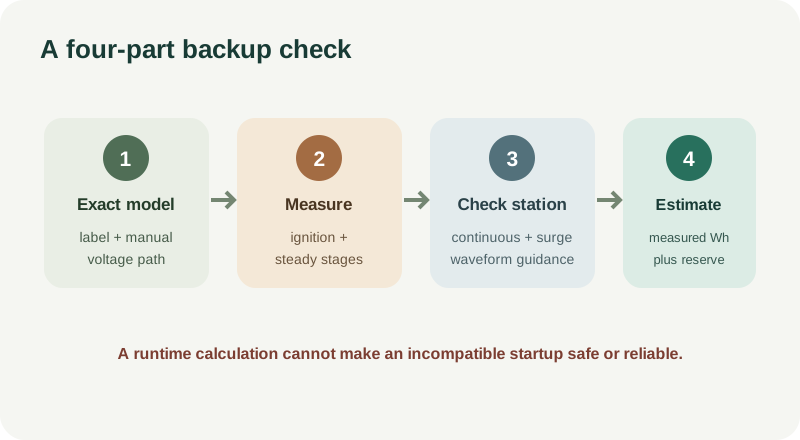
Treat heat and outage operation carefully
An electrical runtime estimate does not establish heat output, room temperature, combustion quality, venting, installation, or indoor safety. Keep fuel handling, venting, and service within the appliance manual and qualified technician guidance. The ComfortBilt HP22 outage instructions include close-door and no-automatic-restart behavior; restored electricity does not guarantee a safe restart. Plan for the manufacturer’s restart procedure and alternate heating for a longer outage.
For a named RV furnace, check whether the manual specifies DC input, fuse requirements, and coach-system conditions before any backup plan. Dometic’s DFMD16 example is a 12 V furnace with an electrical input rating of 50 W / 4.2 A; Suburban’s SF-Q series lists a 12 V, 5.1 A requirement. Those are separate product examples, not measured average demand or runtime. They do not authorize connecting a third-party station to installed wiring. Use a qualified RV technician for any change to the installed supply path.
Apply the runtime calculator to measured Wh only after checking continuous output and startup surge. Confirm the exact model manual and current revision before relying on a backup arrangement.