Aquarium Heater, Filter, and Air Pump Runtime from a Portable Power Station
Estimate aquarium backup energy by listing the heater, filter, and air pump separately, then preserve exact model, voltage, and aquatic-life limits.
An aquarium may rely on several electrical devices at once. The heater cycles as water temperature changes, while a filter and air pump may be intended to run continuously. Build the estimate from the exact equipment list and its operating pattern; do not assume that keeping one device on preserves water quality, oxygen, or animal health for a particular time.
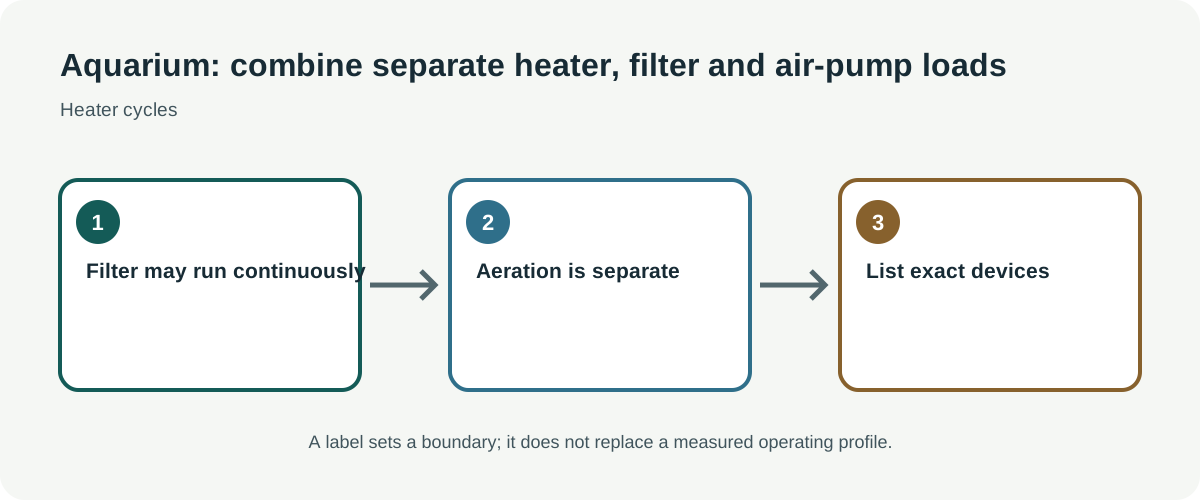
Keep the product examples and regions distinct
Aqueon’s U.S. adjustable submersible heater manual lists 50, 100, 150, 200, and 300 W models for 120 V, 60 Hz use. The thermostat switches heating according to conditions, so rated watts are not a continuous average. The manual requires the heater to remain submerged and describes safeguards for improper water level or overheating. Follow the manual during setup and never run it outside its specified water conditions.
Fluval lists the U2 underwater filter at 5 W for both 120 V, 60 Hz and 230–240 V, 50 Hz contexts, and describes continuous operation. The U.S. Fluval A202 air pump is listed at 3 W for 120 V, 60 Hz and 3.8 W for 230–240 V, 50 Hz. These are three different pieces of equipment and separate regional profiles. Verify the label for each actual appliance; do not transfer a U.S. heater specification to a 230 V aquarium or treat the air pump’s flow rating as electrical energy.
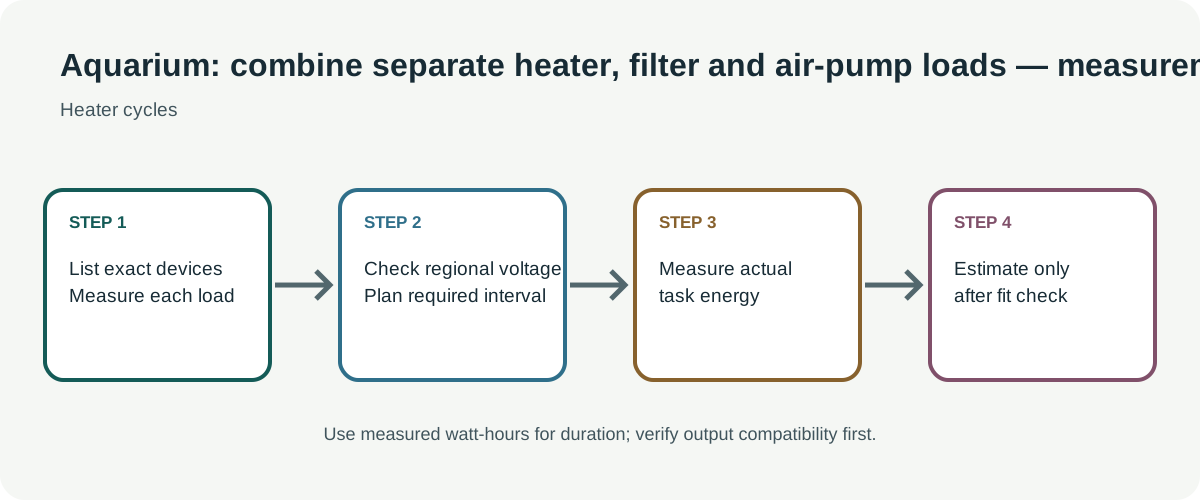
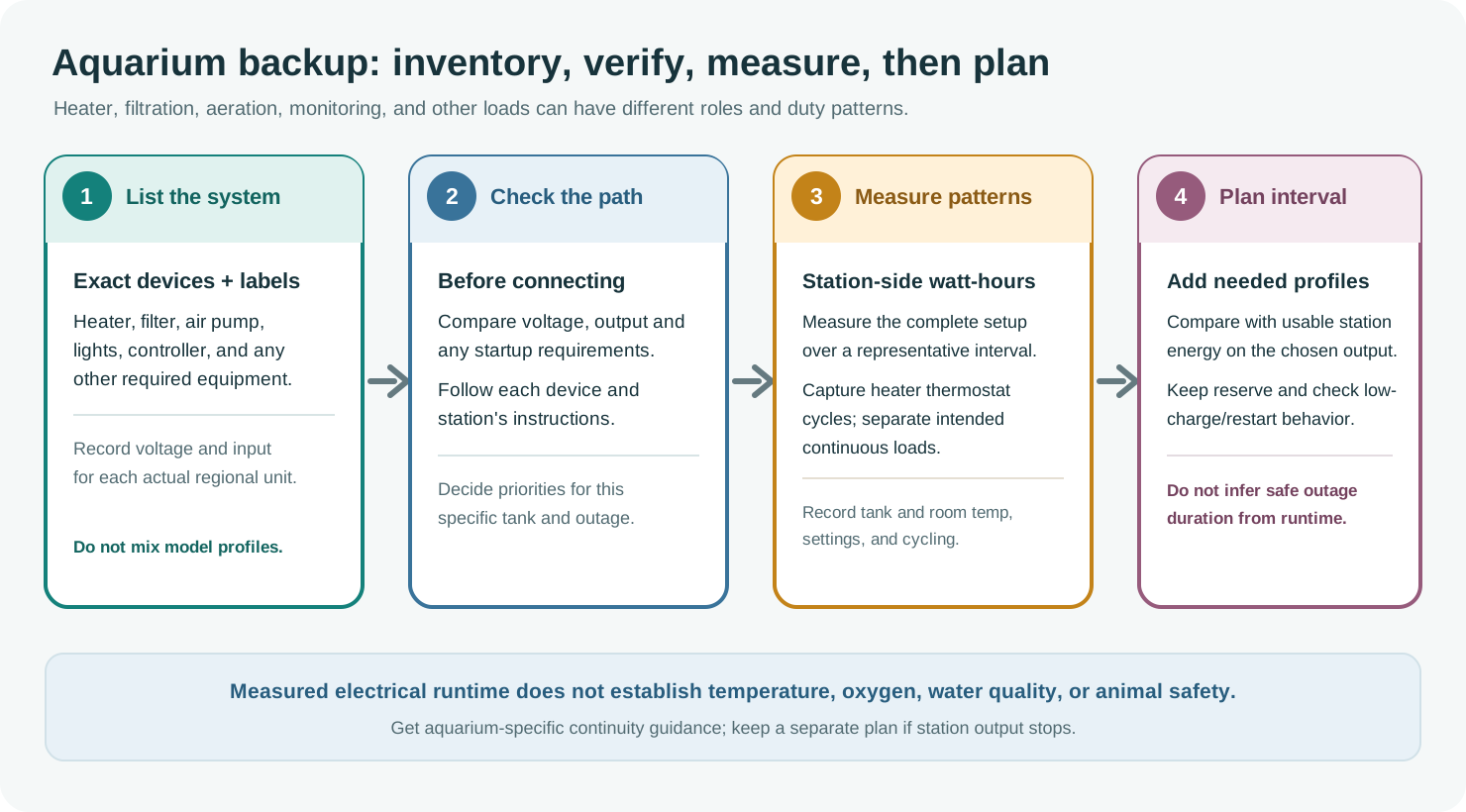
Build a complete load inventory
List each heater, filter, pump, light, controller, and other item that must remain on. Record its exact voltage and input limit, then check station outlets, continuous AC/DC output, and any startup requirement. The U2 is a low-power continuous example, but an aquarium heater can dominate the total load when it is energized. If a compressor or pump cycles, its start and the station’s surge response are separate from total watt-hours.
Do not add every nameplate wattage and call the result an average. That may be a conservative all-on output scenario, but it does not represent thermostat-controlled heater energy. Conversely, do not assume the filter rating covers the aquarium: lights, circulation, air, temperature control, and monitoring may all matter for the specific tank. Measure each circuit safely and keep the original safe grounding and water protection.
Measure the needed backup interval
Where both manufacturers permit the setup, measure station-side Wh for each device and for the complete aquarium arrangement over a representative interval. Record ambient temperature, water temperature, heater setting, filter condition, air-control setting, and which devices cycled. For a continuous filter or air pump, energy over a known interval can be projected only while its operating conditions stay comparable. For a thermostat-controlled heater, measure enough time to capture cycles rather than sampling only when it is off or on.
Add the measured components for the interval and compare with the station’s usable energy on the selected output. Keep reserve for colder conditions, station losses, aging, other loads, and uncertain cycle behavior. Check how the station handles low charge and output restart; an automatic restart is not proof that aquarium systems recover safely.
Runtime is not an aquatic-life guarantee
A power estimate does not establish a safe water temperature, oxygen level, circulation rate, or outage duration for fish and other aquatic animals. Ask an aquatic veterinarian or knowledgeable aquarium professional which equipment is critical for the particular tank and what non-electrical steps are appropriate. Have a separate plan if the station fails or the indoor temperature changes. Do not leave a heater, filter, or air pump running in a configuration that violates its manual.